What Is a Development Appraisal? Profit on Cost, Profit on GDV and Residual Land Value
A plain guide to development appraisals for property and real estate developers: the two forms, profit on cost versus profit on GDV, how an appraisal differs from a valuation, and how to test it.
Quick answer
A development appraisal sets a scheme's gross development value (GDV) against its costs. With the land price as an input, it gives the developer's profit, usually expressed as profit on cost or profit on GDV. With a target profit as an input, it gives the residual land value: what the scheme can afford to pay for the site. Profit on cost is always higher than profit on GDV for the same scheme (20% on GDV is 25% on cost). An appraisal rests on the developer's assumptions, so it is a decision tool, not a formal valuation.
Every development decision eventually comes down to one question: does the scheme carry enough value to cover its land, its costs and the risk of building it? A development appraisal is how that question is answered, and how the answer is shared with a partner, an investment committee or a lender.
The terms vary by market. UK and Irish developers usually talk about a development appraisal and profit on cost or on GDV. North American developers usually build a development pro forma, which adds a dated cash flow and return measures such as IRR. The underlying arithmetic is the same.
What a development appraisal calculates
RICS defines a development appraisal as a financial appraisal of a development that is "normally used to calculate either the residual site value or the residual development profit". Both forms start from the same place: the value of the completed scheme minus the cost of delivering it.
- Residual development profit. The land price is known (agreed, offered or already paid), so it is treated as a cost. What is left after all costs is the developer's profit.
- Residual land value. A target profit is treated as a cost instead. What is left is the most the scheme can afford to pay for the land.
Which form to run depends on the decision. Before an offer, the land-value form tells you what the site can support. Once the price is fixed, the profit form tells you whether the scheme still earns enough for its risk, and what happens when the design, costs or sales values move.
What goes into an appraisal
A useful appraisal keeps every material input visible and separately stated:
- Gross development value (GDV): expected sales receipts or capitalised rents for the completed scheme.
- Land and acquisition costs: the price, plus taxes, legal and agency costs of buying it.
- Build costs: construction, usually a rate per square metre or square foot of gross area, plus demolition, site works and any abnormal costs.
- Professional fees and contingency: usually percentages of build cost.
- Planning obligations: contributions, levies and affordable housing assumptions where they apply.
- Finance: interest on the money borrowed over the programme.
- Selling costs: agency, legal and marketing on disposal.
- Programme: how long the scheme takes, which drives the finance cost.
The appraisal is only as strong as these inputs. A single optimistic figure hidden inside a total is the most common way an appraisal misleads the people relying on it.
Profit on cost vs profit on GDV
Profit is GDV minus total costs, including land. It is then expressed as a percentage in one of two ways:
- Profit on cost = profit ÷ total costs. It shows the return on the money spent.
- Profit on GDV (also called profit on revenue) = profit ÷ GDV. It shows the share of the scheme's value kept as profit.
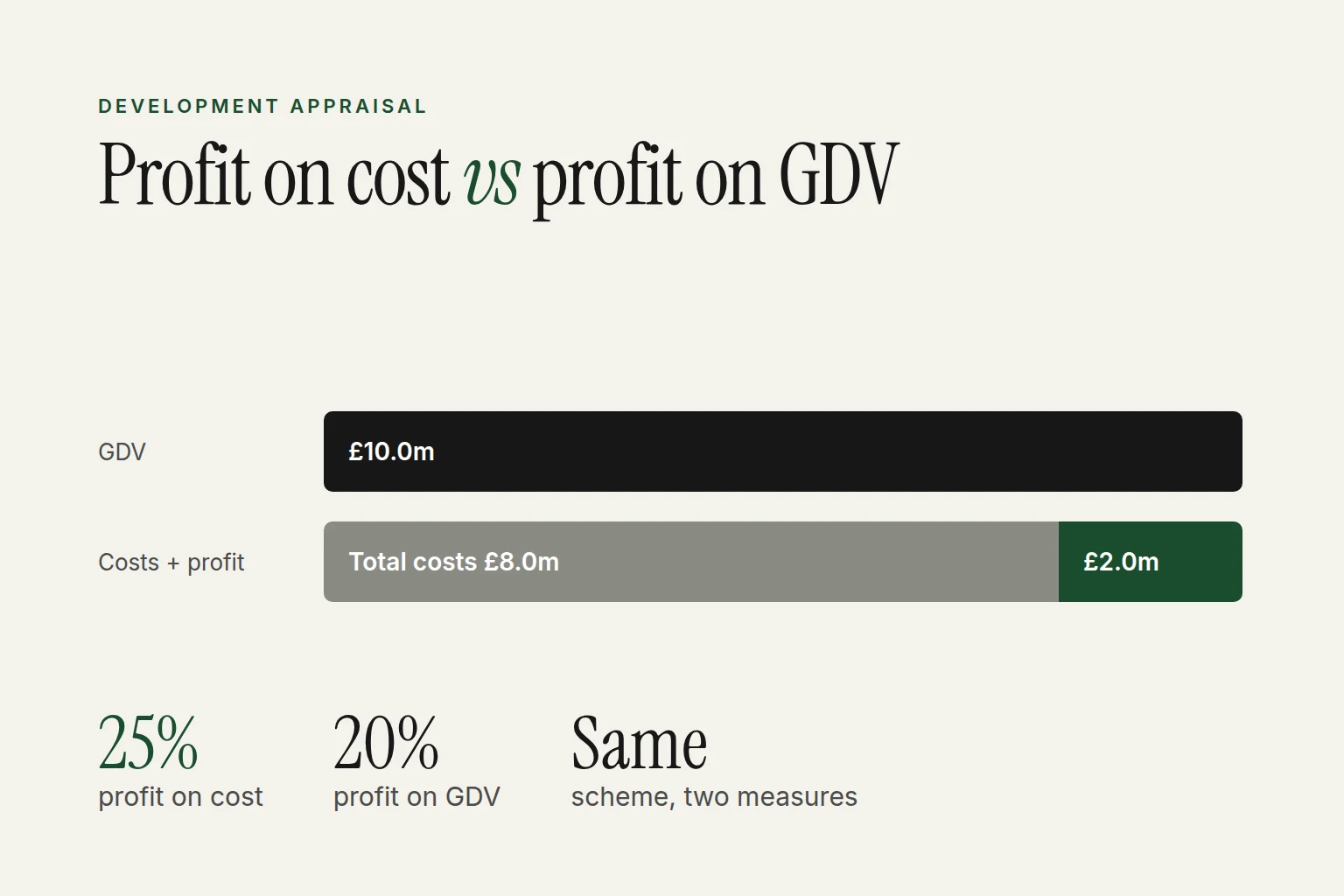
For a scheme with a GDV of £10,000,000 and total costs of £8,000,000, profit is £2,000,000. That is 25% on cost but 20% on GDV. The two measures describe the same result, so always say which one a target refers to. To convert, profit on cost = profit on GDV ÷ (1 − profit on GDV):
| Profit on GDV | Profit on cost |
|---|---|
| 15% | 17.6% |
| 17.5% | 21.2% |
| 20% | 25.0% |
In England, the government's planning practice guidance on viability says a return of 15 to 20% of GDV may be considered suitable for plan making, while allowing other figures where the type, scale and risk of development justify them. Individual developers, partners and lenders set their own hurdles.
A development appraisal is not a valuation
An appraisal is the developer's own model of a scheme, built on the developer's assumptions for their own decision. A formal valuation of development property is a different exercise: it is carried out by a valuer under professional standards, for a stated purpose and basis of value, and reported accordingly.
The two use similar arithmetic, which is why they are often confused. Treat an internal appraisal as evidence for a decision, not as a valuation for a lender, a purchaser or a court. If a formal valuation is needed, instruct one.
Basic residual or cash flow
RICS describes two ways of applying the residual method. A basic residual appraisal treats costs and receipts in simple totals, with finance approximated over the programme. It suits early decisions and less complex schemes. A discounted cash flow places each cost and receipt in the month or quarter it happens, which matters for phased delivery, staged sales and funding structures, and it produces an IRR.
Most development teams start with the basic form to test a site and move to a cash flow as the scheme firms up and funding is arranged. A US development pro forma is usually the cash-flow form from the start.
Test sensitivity before trusting one number
An appraisal that shows one profit figure hides how fragile that figure is. Test what happens when the inputs move:
- sales values fall by 5% or 10%;
- build costs rise by 5% or 10%;
- the land price changes;
- the programme runs three or six months longer.
If a modest change turns an acceptable margin into a loss, the appraisal is telling you where better evidence is needed before committing: cost advice, comparable sales, a firmer programme or a different land position. RICS guidance on viability in planning likewise expects scenario and sensitivity testing rather than a single outcome.
Keep the appraisal tied to the scheme and the site
Appraisals drift when they are copied between spreadsheets and the scheme moves on. Tie each appraisal to the exact option it prices (its homes, floorspace and storeys) and to the site evidence behind its assumptions, and record where each figure came from.
Atlasly Developments runs the profit form of a basic residual appraisal. Each appraisal is pinned to one option revision. Every input is tagged as supplied, an estimate or an assumption, and missing inputs stay "not known" rather than being filled in. It shows profit, profit on cost and profit on GDV, a cost breakdown, and sensitivity to sales, build cost, land price and programme. Finance is approximated as the annual rate on land, acquisition costs and half the construction spend over the programme. It does not produce a dated cash flow, IRR or residual land value, and it is not a valuation. For a quick land-side screen, use the free residual land value calculator. Before exchange, work through the site due diligence checklist.
Illustrative example
The most useful appraisal conversation is usually about the inputs, not the answer. A committee that can see which figures are supplied, which are estimates and which are still assumptions asks better questions than one shown a single margin to approve.
Frequently asked
What is a development appraisal?
A financial appraisal of a development that sets its gross development value against its costs. It is normally used to calculate either the developer's residual profit, when the land price is known, or the residual land value, when a target profit is set.
What is the difference between profit on cost and profit on GDV?
Profit on cost divides profit by total costs; profit on GDV divides it by gross development value. For the same scheme profit on cost is always higher: 20% on GDV equals 25% on cost.
What profit margin do property developers target?
It depends on the scheme's risk, type and funding. In England, planning guidance on viability treats 15 to 20% of GDV as a suitable return for plan making, but individual developers and lenders set their own hurdles.
Is a development appraisal the same as a valuation?
No. An appraisal is the developer's own model for a decision, built on its own assumptions. A formal valuation is carried out by a valuer under professional standards for a stated purpose and basis of value.
What is the difference between a development appraisal and a pro forma?
They answer the same question. A development pro forma, the usual North American term, typically lays costs and receipts out as a dated cash flow and reports IRR. A basic development appraisal uses simple totals with finance approximated over the programme.
Conclusion
A development appraisal is only as good as the inputs behind it and the honesty of its sensitivity testing. State which profit measure you are using, keep each figure's source visible, tie the appraisal to the exact scheme it prices, and treat it as evidence for a decision rather than a valuation.

About the author
Shatakshi Patil
Architect writing about pre-construction due diligence, planning context, and site intelligence workflows for design teams using Atlasly.
Sources and references
Authoritative references for the planning policies, regulations, and standards referenced in this article. Always check the publisher for the latest version.
Related articles
Auto-suggested
Development
Site Due Diligence: 30 Questions Every Developer Should Answer Before Exchange
A working developer checklist of 30 site due diligence questions covering planning, environmental, legal, physical, and market risks before exchange of contracts.
Read
development feasibility analysis
Development Feasibility Analysis: FAR, Buildable Area, and Financial Viability for Architects
How architects can use FAR calculations, buildable area analysis, and early-stage financial viability screening to test development feasibility before committing design time.
Read
Development feasibility
Residual Land Value: A Practical Early-Stage Check for UK Sites
How architects and development teams can use a residual land value check to test an early UK scheme, understand the inputs, and avoid treating a quick appraisal as a final valuation.
Read
site feasibility study checklist
Site Feasibility Study Checklist: 12 Things to Assess Before Your Design Brief
A practical 12-point checklist covering planning, physical, environmental, access, and viability factors that should be tested before briefing design work.
Read